
Real cost, timeline, and outcome data from 108 B2B ecommerce replatforming engagements. Not vendor estimates — confirmed billing actuals and documented project outcomes from Classy Llama's 2018–2026 portfolio.
B2B ecommerce replatforming is one of the most consequential — and least documented — investments a mid-market B2B company can make. Public data is dominated by platform vendors with an interest in selling licenses and analyst firms that rarely sit inside the actual project. As a result, the questions B2B leaders most want answered before signing an SOW — How much will this really cost? How long will it really take? Will it actually work? — usually get answered with a shrug and a vendor pitch.
This report addresses that gap. It is built from 108 client replatforming and rebuild engagements completed by Classy Llama between 2018 and 2026, covering Adobe Commerce (Magento), BigCommerce, Shopify Plus, and custom platforms. Confirmed actual budget data — pulled from internal billing records — exists for 56 of them.
Cost spans three orders of magnitude. Confirmed billed totals range from ~$5K (a single-line code audit) to $2.14M (a full Adobe Commerce replatform). The median full-build engagement lands at $154K for Tier 2 projects (n=14) and $383K for Tier 3 projects (n=7).
Where the underlying data exists, the numbers in this report are actual project outcomes — budgets that were billed, days that elapsed, percentages that were measured. Where data is absent, sample sizes are stated explicitly.
All data in this report comes from two first-party Classy Llama systems:
Each project is classified by data completeness. Statistics in this report always name their sample size (n=). A median timeline reported as "n=9" reflects only the 9 projects with both confirmed start and launch dates — not all 108.
It is: A defensible, first-party look at what real B2B replatforming projects actually involve — budgets that were billed, timelines that elapsed, outcomes that were measured.
It is not: A random sample of all B2B ecommerce projects, an industry-wide cost survey, or a predictive model. A "median 6-month timeline" does not mean your project will take 6 months. Selection bias is real: clients who hire Classy Llama tend to be mid-market distributors, manufacturers, and B2B retailers skewed toward Adobe Commerce historically.
Of 91 cataloged projects, Adobe Commerce accounts for approximately 62%. BigCommerce has gained notable share — three new projects launched in late 2025–early 2026. Shopify Plus is the newest entrant as a credible B2B destination for unified D2C+B2B storefronts.
Across 30 projects with both source and destination platforms confirmed, representing 15 distinct migration patterns, the modal scenario is "Custom → Platform": companies replacing a custom-built or content-managed system (DNN, WordPress, ASP.NET, in-house). B2B companies rarely start a replatform from nothing.
Increasingly. Several active hybrid patterns appear in this dataset:
"Headless or not" is no longer binary. Partial, pragmatic headless is increasingly the answer.
Not all B2B replatforms are equal. Three tiers consistently emerge from the data, distinguished by integration count, B2B workflow depth, multi-storefront requirements, and catalog size.
| Tier | Profile | Typical Cost | Typical Timeline |
|---|---|---|---|
| Tier 1 Standard |
Single storefront, 1–3 integrations, basic B2B features or D2C-leaning B2B, <50K SKUs | $30K–$115K | 1–6 months |
| Tier 2 Moderate |
1–2 storefronts, 2–5 integrations, real B2B workflows (PO fields, customer pricing, credit limits), 10K–200K SKUs | $120K–$225K (median $154K, n=14) |
6–12 months |
| Tier 3 Complex |
Multi-storefront or multi-ERP, 4+ integrations, deep B2B workflows (punchout/cXML, custom quoting, branch-specific catalogs), 100K+ SKUs | $400K–$600K+ (median $383K, n=7) |
12–30 months |
The most important question to answer before you start planning: Are you Tier 1, Tier 2, or Tier 3? The right budget and timeline depend on this answer more than on platform choice.
Based on 56 confirmed billing actuals from Salesforce internal financial records, export date April 13, 2026. Numbers are billed totals, not estimates or quotes.
Confirmed billed totals range from ~$5K (a single-line code audit) to $2.14M (a full Tier 3 Adobe Commerce replatform). The median is well below the mean, reflecting a long-tailed distribution: most engagements are small-to-mid-range, but a handful of Tier 3 builds anchor a much higher ceiling.
Tier 2 builds — full B2B replatforms with ERP integration, typically single-storefront — cluster tightly in the $120K–$225K band. This describes most full B2B replatforms in this dataset. The $154K median is well-supported by confirmed actuals.
| Project (Anonymized) | Confirmed Billed Total | Notable Characteristics |
|---|---|---|
| Material Supply Warehouse | $2,140,000 | Full Adobe Commerce replatform; multi-phase |
| Agricultural Equipment Dealer | $629,000 | Stage 2–3; Celigo integration |
| Solar Supply Company | $533,000 | Stage 3 |
| Calibration Services Provider | $480,000 | Multi-phase redesign |
| Industrial Equipment Distributor | $459,000 | Stage 3; 10x page load improvement post-launch |
| Replacement Auto Parts | $399,000 | Full Adobe Commerce rescue build |
| Precision Automotive Components | $383,000 | BigCommerce build; ~730-day timeline |
| Source: Salesforce billing export, April 13, 2026. Eight engagements crossed $300K in confirmed billings. | ||
Rescue premium is real. Budget overruns of 2–3x the original quote are typical when rescuing a failed prior project. The "we're 70% done, just finish it" framing routinely understates what remains — commonly because merchants overestimate the completeness of work left by the prior agency.
Add a 20–30% contingency to any build estimate. For rescue engagements, expect to roughly double whatever the remaining-work estimate says.
Confirmed kickoff and launch dates both known for n=9 projects.
Timeline ranges from ~90 days (Shopify Plus with constrained scope) to 730+ days (Tier 3 multi-storefront, multi-ERP). Timeline is driven by integration count, not platform choice.
| Scenario | Typical Duration | Key Driver |
|---|---|---|
| Shopify Plus (constrained scope, D2C+B2B) | ~90 days | Platform simplicity + limited B2B workflow requirements |
| Tier 2 (single storefront, 2–4 integrations) | 6–12 months | ERP integration complexity |
| Tier 3 (multi-storefront or 4+ integrations) | 12–30 months | Integration count; multi-ERP; deep customization |
| Rescue engagement | Add 6–12 months to estimate | Hidden scope from prior agency; technical debt |
Yes. In this dataset, projects with 5+ integrations consistently take 12+ months, regardless of platform. A Tier 2 project on Adobe Commerce with 2 integrations can launch in 6 months. A BigCommerce project with 6 integrations and a multi-storefront requirement will take 18+ months.
Quantitative post-launch outcomes documented for n=10 projects.
Post-replatform revenue gains of 17–80% are documented in the projects where measurement was performed. Site speed improvements are reliable. Rescue engagements tend to produce the largest gains because the prior platform was so degraded.
| Outcome Category | Documented Results |
|---|---|
| Revenue / Traffic |
Navigation & Performance Supplier: +337% users, +355% sessions, +80% revenue post-launch Auto Fitment Retailer: +25% revenue post-rescue launch National HVAC Supply: +500% parts sales over 18 months (client-verified quote) |
| Site Speed |
Industrial Equipment Distributor: 10x page load improvement (8–10s → <1s) Multiple projects: meaningful Core Web Vitals gains documented |
| Customer Experience | Replacement Auto Parts: customer rating flip from 1-star to 5-star — the cleanest qualitative signal in the dataset |
| Note: Many projects in the portfolio had similar outcomes that were never measured by the merchant. Measurement setup before launch is strongly correlated with documented improvement in this dataset. | |
"500% increase in parts sales over 18 months." — National HVAC Supply (direct client quote, verified)
12 distinct B2B feature categories were observed across the dataset. Adoption clusters by complexity tier.
| Feature Category | Typical Tier | Notes |
|---|---|---|
| Customer pricing / price lists | Tier 2+ | Among the most common B2B requirements |
| PO fields / order references | Tier 2+ | Common in all mid-market B2B builds |
| Credit limits / net terms | Tier 2+ | Usually requires ERP sync |
| Customer groups / company accounts | Tier 2+ | Core to most B2B storefronts |
| Branch-specific catalogs | Tier 3 | Requires multi-storefront or complex catalog rules |
| Custom quoting / RFQ | Tier 3 | Typically custom development |
| PunchOut / cXML | Tier 3 | Rare in this dataset — Material Supply Warehouse is the only confirmed cXML implementation |
| Customer approval workflows | Tier 3 | Notable absence — may reflect mid-market positioning |
There is no single dominant ERP in B2B mid-market. Classy Llama's dataset includes 11 named ERP systems: NetSuite, Infor SyteLine, Microsoft Dynamics, Sage, Epicor, Agility, and others. The diversity here is real and reflects the fragmented mid-market ERP landscape.
Celigo is the dominant iPaaS in this dataset, appearing in 5+ engagements: Precision Automotive Components, Display & Graphics Manufacturer, Chemical & Equipment Supplies, Specialty Retailer, Agricultural Equipment Dealer, and Modular Framing Supplier.
Other patterns observed:
| Integration Count | Typical Timeline | Complexity Tier |
|---|---|---|
| 1–3 integrations | ~6 months | Tier 1 / Tier 2 |
| 4–6 integrations | ~12 months | Tier 2 / Tier 3 |
| 6+ integrations | 18–24+ months | Tier 3 |
| Integration count is the strongest single predictor of complexity tier and timeline in this dataset. | ||
A rescue engagement involves taking over a B2B replatforming project from a previous agency — or replacing a failed prior platform attempt. At least 8 of the 18 highest-detail projects in this dataset are rescues.
Three architectural patterns appear in this dataset that don't have widely-used industry names, but are working in production and worth understanding before making a "headless or not" decision.
Example: Building Products Manufacturer. WordPress is retained as the marketing/content site (preserving SEO investment); BigCommerce handles commerce functionality with checkout on a BigCommerce subdomain or embedded.
Why teams choose it: Existing WordPress SEO is too valuable to discard, but a marketing-only site needed to add commerce without rebuilding from scratch.
Example: Chemical & Equipment Supplies. Magento serves the educational catalog (the majority of revenue is offline); BigCommerce checkout is iframed into Magento product pages for online sales.
Why teams choose it: PCI compliance and checkout reliability via BigCommerce, while Magento retains full content and catalog control. SEO score of 91/100 within days of launch suggests this pattern does not penalize search visibility.
Example: Multi-Brand Auto Parts Portal. Each of five specialty automotive brands has its own WordPress catalog site. All five embed Magento cart and checkout widgets, with a single underlying Magento instance handling all commerce.
Why teams choose it: Independent brand identity and content control per vendor; centralized inventory, order management, and fulfillment.
These three patterns suggest the "should I go headless?" question is increasingly answered with partial / pragmatic headless rather than full decoupling.
Based on 56 confirmed billing actuals from Classy Llama's 2018–2026 portfolio:
Add 20–30% contingency. If rescuing a failed project, roughly double the remaining-work estimate.
Based on 9 projects with confirmed kickoff and launch dates: approximately 90 days for a constrained Shopify Plus replatform; 6–12 months for a Tier 2 B2B build with ERP integration; 12–30 months for Tier 3 builds with 4+ integrations or multi-storefront requirements. Timeline is driven primarily by integration count, not platform choice.
In Classy Llama's portfolio of 91 cataloged projects, Adobe Commerce (Magento) accounts for approximately 62% of projects. BigCommerce has been gaining share with 3 new projects in late 2025–early 2026. Shopify Plus is an emerging B2B option for unified D2C+B2B storefronts.
Both have documented B2B success stories in this dataset. Platform choice is less important than fit with your existing tech stack, especially your ERP. Adobe Commerce offers deeper B2B workflow capabilities for complex catalogs. BigCommerce typically offers faster time-to-launch and simpler operations. Shopify Plus is a credible option for companies with both D2C and B2B channels on a unified storefront.
There is no single dominant ERP in mid-market B2B. This dataset includes NetSuite, Infor SyteLine, Microsoft Dynamics, Sage, Epicor, Agility, and Fishbowl, among others. Celigo is the dominant iPaaS middleware, appearing in 5+ engagements. ERP integration is the most common source of scope creep and timeline extension in B2B replatforms.
A rescue engagement involves taking over a stalled or failed B2B replatforming project from a previous agency. At least 8 of the 18 highest-detail projects in Classy Llama's dataset are rescues. Budget overruns of 2–3x the original quote are typical. The "we're 70% done, just finish it" framing routinely turns into 12–24 additional months of work. However, rescue projects also tend to produce the largest post-launch performance improvements.
Based on 10 projects with documented outcomes: revenue gains of 17–80% are documented. Site speed improvements are reliable (one project went from 8–10 seconds page load to under 1 second). One project saw +337% users and +80% revenue. National HVAC Supply reported a 500% increase in parts sales over 18 months.
Add 20–30% contingency to any B2B replatforming estimate. For rescue engagements (taking over a failed prior project), expect to roughly double whatever the remaining-work estimate says.
PunchOut2Go-style integrations are rare in this dataset — Material Supply Warehouse is the only confirmed cXML implementation. Customer approval workflows (multi-buyer purchasing hierarchies) are notably absent, which may reflect the mid-market positioning of the client base. Customer pricing, PO fields, credit limits, and company accounts are the most common B2B features across Tier 2+ projects.
All data is first-party from two Classy Llama systems: Atlassian Confluence (209 spaces covering 25+ case studies, 13+ SOWs, launch checklists, and project documentation) and Salesforce billing records (89 line items, $8.91M total, export April 13, 2026). Confirmed billing actuals exist for 56 of the 108 projects in the dataset. This is not a vendor-sponsored survey or analyst report — it is one agency's real project portfolio.
| Data Type | Sample Size | Confidence Level |
|---|---|---|
| Total projects cataloged | n=108 | High |
| Confirmed billing actuals | n=56 | High — pulled directly from internal billing records |
| Confirmed migration paths (source + destination) | n=30 | Medium-High |
| Confirmed timeline (kickoff + launch dates) | n=9 | Medium — small sample; patterns are consistent but range is wide |
| Documented post-launch outcomes | n=10 | Medium — limited to projects with measurement setup before launch |
This report is strongest as a landscape and cost-distribution benchmark (backed by 56 confirmed actuals) and weakest as a source of post-launch revenue and timeline metrics (n=9–10). Gaps are expected to close in 2026 H2 with targeted client outreach to the top 15 priority projects.
This report was produced by Classy Llama, a B2B ecommerce agency headquartered in Springfield, Missouri, specializing in Adobe Commerce, BigCommerce, and Shopify Plus. All data is derived from internal project documentation spanning 2018 to 2026.
Classy Llama. (2026). B2B Commerce Replatforming Benchmarks 2026. Springfield, MO. Retrieved from https://www.classyllama.com/research/b2b-replatforming-benchmarks-2026
Corrections and additions: If you are a Classy Llama client whose project is referenced in this report and would like to be credited by name, or if you have additional metrics to contribute, contact us at classyllama.com/contact.
Next planned revision: EOY 2026, following targeted client outreach to fill SKU count, exact date, and post-launch revenue gaps for the top 15 priority projects.
Data created: April 13, 2026. Published: May 5, 2026.
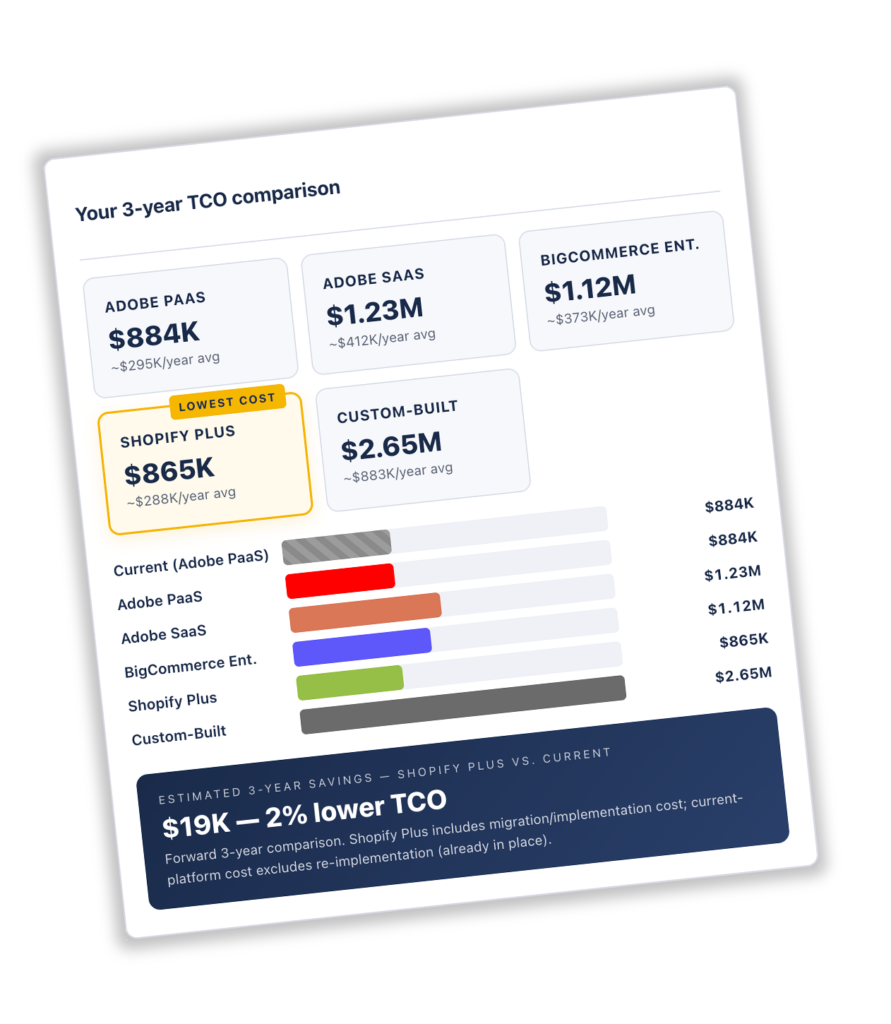
What does it truly cost to move from one platform to another? Try our proprietary calculator to find out.